The plows and salt trucks have been busy the last few months and they are not finished yet. This is not the type of equipment we like to see. My husband and I look forward to the first of the farm equipment on the roads and in the fields for another season.

That time is months away.
Going through some photos last week, I found pictures of old tractors which were on display in a yard in St. Chrysostome, Prince Edward Island last summer.

The tractors are part of a history which illustrates an economic and some would say political problem.

Two companies which made tractors, Oliver and Minneapolis-Moline in the United States were each formed from a combination of smaller companies in rural parts of the country. A third company, Cockshutt Plow was a family owned Canadian business.
Beginning in 1960, the White Motor Company of Ohio bought the Oliver Farm Equipment Company, expanding its business to agriculture as well. Later, in that decade, White purchased Minneapolis-Moline and Cockshutt. Small manufacturers disappeared as larger companies gobbled them up. Jobs disappeared from rural areas to larger centers.
Over time, the same occurred across manufacturing and has become part of the problem we see today in the western world. Middle class jobs have disappeared from rural areas and job training for a new economy has not kept up. Now, as computers and automation take over, the problems will multiply. Before long for example, automated trucks will work at mining sites and eliminate the need for truckers there. The problem is further complicated by companies sending jobs overseas where costs are lower.
In St. Chrysostome, the display includes the Cockshutt 20, a row-crop tractor, built in Brantford, Ontario. There were only 4,000 of them built and in 1953, they cost $2300 U. S.

An Oliver 1655 by White, in production from 1969-75, is also displayed. In 1975, it cost $10,000 U. S.

Also on display was the Farmall 300, built by Farmall, a branch of International Harvester of Illinois, from 1954-56. In 1956, the cost was $2900 U. S.
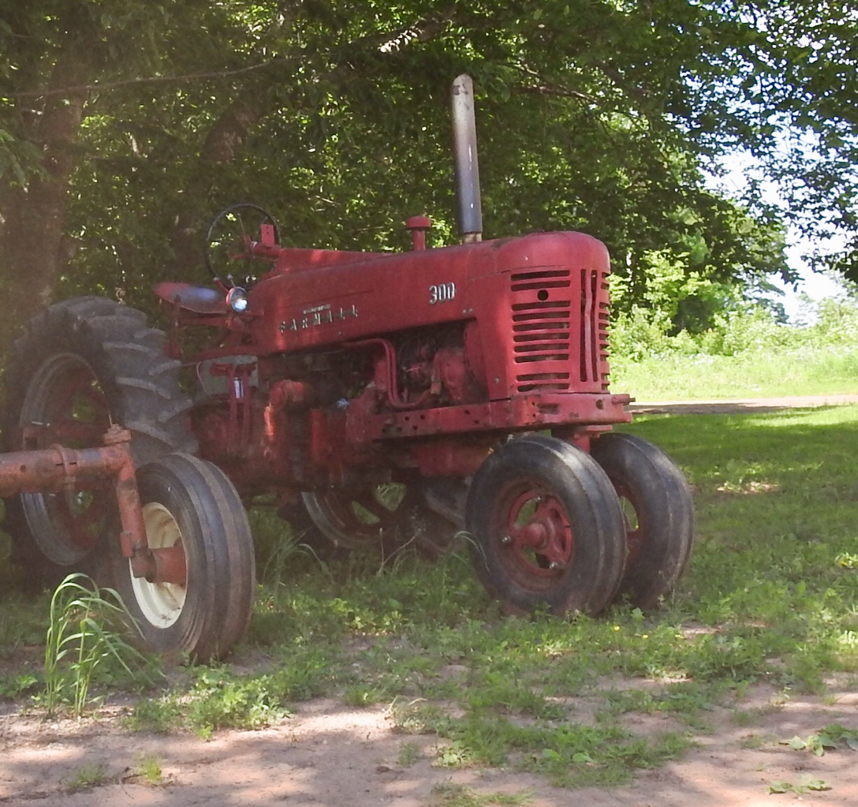
Today International Harvester, itself formed from a two company merger, is known as Navistar International Corporation, a holding company based in Illinois. The company is also in the defense business and has developed hybrid and electric vehicles as well, far beyond the agriculture business where it began. It has facilities on six continents and dealers in ninety countries, globalization at work.
This Zetor tractor is made in the Czech Republic. It found its way to rural Prince Edward Island, evidence of such globalization.

We saw a farmer on a tractor at the harvest display at Kool Breeze Farm in Summerside. He looked a bit tipsy.

Is it any wonder?
I remember Cockshutt tractors and the International Harvester brand. All those other brands are unknown to me though. On the prairies there were lots of Massey-Harris-Fergusons, another Canadian make. Love the final photo!
ReplyDeleteI didn’t know any of these tractors, Debra. My grandfather used a horse and plow.
DeleteLovely pictures of bygone days. Growing up in the City I didn't see any farming but not far outside the city was miles and miles of farms with all their glorious equipment.
ReplyDeleteThe old tractors were fascinating to see, Barbara.
DeleteIn the days of steam traction engines just about every small town in the east of England had its own manufacturer. Most of these were blacksmiths who diversified into mending other bits of farm equipment before making the huge leap into making steam-driven engines. They not only succeeded but many of their machines have survived a century or so and are still running today. Sadly since those early days the same thing has happened here as larger and larger manufacturers grew at the expense of the smaller firms. Not many modern machines will survive till the next century.
ReplyDeleteI can’t imagine the modern ones lasting either, John.
DeleteThe little fish have been eaten by the bigger fish since the beginning of time. I've personally suffered, as have so many middle class, by the loss of manufacturing jobs. The peripheral loss probably isn't even noticed by the big fish, which spits out all it does not like of the company acquired. The smaller company did something the big company wanted, but any peripheral manufacturing was sloughed off, to survive, or go under. Generally the latter. Perhaps that tractor company sharpened tools or made some specialty farming product. Probably the big company said it cost too much to underwrite, and closed it down.
ReplyDeleteThe way of the world, the big fish gobbles up everything in its way. Sad but true, Joanne.
DeleteNo wonder at all Marie 😀 I despair at the state of the world today. Automation is such a big thing but the lack of follow through planning for the many people who will lose their jobs because of it is seriously lacking! Love the old tractors, they are so much more photogenic than their modern day replacements ☺
ReplyDeleteThe old ones are fascinating, PDP.
DeleteAutomation is scary. I fear for our grandchildren.
It's the same all over, it seems.
ReplyDeleteThat last shot is perfect!
The last photo was a fun one for sure, William.
Deletehehehe, LOVED that last one!! we have a farmers market nearby that displays old tractors, i always enjoy seeing them!! you captured some great images of them!!
ReplyDeletewe have turned the winter page i think, almost half way through february. i hope spring arrives soon!!
I envy your possibility of spring, Debbie.
DeleteThings have changed in such a short time. I have to wonder about employment in the future. Guaranteed incomes may become necessary.
ReplyDeleteThere is talk of it already, AC, but it may be a necessity in the future.
DeleteGreat tractor pictures, Marie. I LOVE that last tractor. :-)
ReplyDeleteThe last on is my favourite, Jan.
DeleteIt's sad to see all the automation happening everywhere. A lot of our banks have one person working inside, the rest are machines so it kind of forces you to do business that way or online and rural broadband is poor here. So that situation doesn't help people, it's just frustrates them.
ReplyDeleteI love those old tractors. We have lots of them around town. You'll see people drive them as cars to get around town. Some are doing their farm work hauling stuff but others are just driving. Their petro costs must be high. Love that last photo, very creative! Have a wonderful weekend, Marie.
It is amazing those old tractors still work, Bill. Hilarious that they are used as vehicles.
DeleteWhat a lot of fun those old tractors are...and so easy to work on too. Yes, I like the tipsy driver. :)
ReplyDeleteIt amazed me one day...a while ago, to see hay bales no longer square but bigger and round.
Lots of round ones around here now, Mage.
DeleteThere are some really old tractors here in France still working. I agree though I prefer to see them out in spring getting the ground ready for planting. We still see them out every day here though even now carrying hay to all the farm animals. No plough or salt trucks around us, if it is bad we just have to wait until it melts! They only salt the main roads. Enjoy your weekend. Diane
ReplyDeleteYou don’t get snow amounts like we do, Diane.
DeleteI can't wait until spring comes and the fields are tilled also! Andrea
ReplyDeleteIt will be cause to celebrate here, Andrea.
DeleteIs spring just around the corner for us?!!!
ReplyDeleteI hope so, Catarina.
DeleteWe've seen a couple of interesting historic tracor shows here. Things have evolved a long way!
ReplyDeleteThey sure have, FG.
DeleteOh, I do love that last shot! How creative to use the bales and rolls to make the tractor!
ReplyDeleteWe loved it too, Jenny.
DeleteI'd much rather see farm equipment than salt trucks too.
ReplyDeleteAny day, Danielle.
Delete