Most Popular Post

Monday, 12 February 2018

Out of water

A beautiful sunny day drew us out of the house last week. We drove to Stanley Bridge on the north shore where a number of objects which are usually in the sea were prominent on shore. 


The marina at the Bridge has many floating docks where the boats tie up during the warmer seasons of the year. 


This day it was different.


Many of the floating docks were high and dry, stacked on top of each other in the parking lot. 


It is unusual to see what lies beneath a dock, but seaweed and mussels were visible on the pontoons.


On the opposite side of the parking lot, closer to the water, buoys of different sizes were ashore as well. They were brightly coloured and the largest ones dwarf the small shed nearby.


Next to the largest buoys, others of various sizes were piled together. All had mussels and seaweed below their water marks.


There isn’t much room for boat storage in this area but one boat was tucked in below the road. 


And as is often the case, lobster traps, some of the tools of the trade, were stored beside a shack. 


There was activity, as a few people worked in the fishing shacks. An open door gave a glimpse into the domain of the island fishers who are out of water too. However, spring is on the horizon!


Friday, 9 February 2018

Farm equipment

The plows and salt trucks have been busy the last few months and they are not finished yet. This is not the type of equipment we like to see. My husband and I look forward to the first of the farm equipment on the roads and in the fields for another season. 


That time is months away.


Going through some photos last week, I found pictures of old tractors which were on display in a yard in St. Chrysostome, Prince Edward Island last summer. 


The tractors are part of a history which illustrates an economic and some would say political problem.


Two companies which made tractors, Oliver and Minneapolis-Moline in the United States were each formed from a combination of smaller companies in rural parts of the country. A third company, Cockshutt Plow was a family owned Canadian business.


Beginning in 1960, the White Motor Company of Ohio bought the Oliver Farm Equipment Company, expanding its business to agriculture as well. Later, in that decade, White purchased Minneapolis-Moline and Cockshutt. Small manufacturers disappeared as larger companies gobbled them up. Jobs disappeared from rural areas to larger centers.


Over time, the same occurred across manufacturing and has become part of the problem we see today in the western world. Middle class jobs have disappeared from rural areas and job training for a new economy has not kept up. Now, as computers and automation take over, the problems will multiply. Before long for example, automated trucks will work at mining sites and eliminate the need for truckers there. The problem is further complicated by companies sending jobs overseas where costs are lower.


In St. Chrysostome, the display includes the Cockshutt 20, a row-crop tractor, built in Brantford, Ontario. There were only 4,000 of them built and in 1953, they cost $2300 U. S. 


An Oliver 1655 by White, in production from 1969-75, is also displayed. In 1975, it cost $10,000 U. S.


Also on display was the Farmall 300, built by Farmall, a branch of International Harvester of Illinois, from 1954-56. In 1956, the cost was $2900 U. S. 
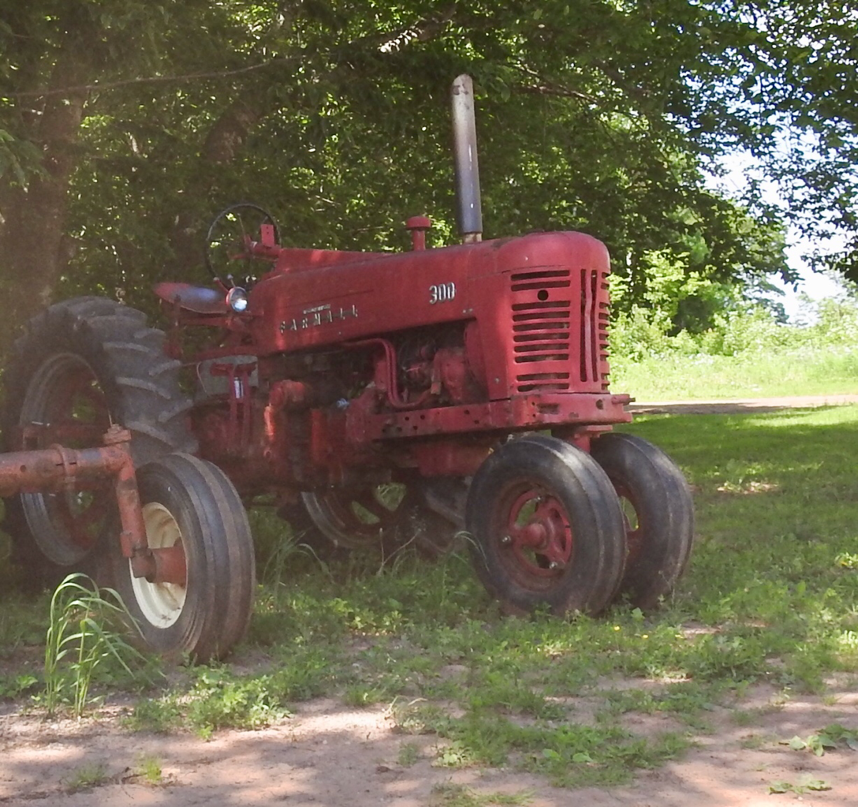


Today International Harvester, itself formed from a two company merger,  is known as Navistar International Corporation, a holding company based in Illinois. The company is also in the defense business and has developed hybrid and electric vehicles as well, far beyond the agriculture business where it began. It has facilities on six continents and dealers in ninety countries, globalization at work.


This Zetor tractor is made in the Czech Republic. It found its way to rural Prince Edward Island, evidence of such globalization.


We saw a farmer on a tractor at the harvest display at Kool Breeze Farm in Summerside. He looked a bit tipsy.


Is it any wonder?

Wednesday, 7 February 2018

Brainy

It was Super Bowl weekend and local news had an article about repetitive brain injury. The article gave me pause since I have had two bumps to my head, one years ago and one recently. When our daughter was young, I tripped going down the basement stairs. My head broke through the plaster of the side wall and I saw stars. Several weeks ago I tripped on the step into the garage and hit my head on the concrete floor. In both cases my hands were full and I couldn’t save myself, which in itself is dangerous enough. With the exception of a headache, I was lucky in both cases.


Another article spoke about research into woodpecker brains since they slam their heads into trees up to 12,000 times a day. The chemical which accumulates in human brains with Alzheimer’s or neurodegenerative diseases appears to be protective in woodpeckers. Further study is warranted.


So the little birds which attract our attention with their tap, tap, tap on trees, 


could be valuable in the research into some of our most dreaded diseases. 


I will never hear that tap again without a thought for the brain behind it.


Monday, 5 February 2018

The best policy

It was an experiment by a regional credit union to test the honesty of people in Atlantic Canada. Twelve wallets containing $100.00 cash, bus tickets, a debit card, receipts and contact information for the owner, were left around the four Atlantic provinces in eastern Canada. Nine of the twelve wallets were returned to the owner, a great result! This story reminded me of an experience I had with my mother years ago.


Mom never used a credit card or cheques. She paid for everything with cash or through the bank. She’d take money out of the bank to pay bills etc. at the end of every month. Besides, bank day was a social occasion!


Every summer after Dad died, I spent some time with Mom. We traveled throughout the province of Newfoundland over the years, stayed in hotels or bed and breakfasts, toured around to see the sights and visited friends and family. We each enjoyed our excursions which always ended at my home.


One year, Mom’s house and car insurance bills were due as we headed for our annual trip. She took the cash from the bank to pay her bills and some extra money for her vacation. She had about $2000.00 in her purse. We headed to pay the insurance but I had to stop at the mall first. While I shopped, Mom waited on one of the benches. She laid her purse down next to her. When I arrived back, I passed her a parcel to carry for me and when we left, she forget her purse, leaving it on the bench.


At the top of an escalator we realized Mom’s purse was back on the bench. Panic set in as we headed back down there, within five minutes. The purse was gone.


This was a huge loss for Mom who was not wealthy. She would have saved all year to pay her insurance and have a vacation. We were devastated.


“Maybe someone turned it in to Lost and Found,” I said. “We’ll check there.”


Neither of us knew where the office was so it took fifteen minutes to locate. Sure enough, a man had turned in the purse with everything in it. We had passed him on the way into the office so Mom was able to thank him and give him a small reward. There are good and honest people in this world and we were fortunate to encounter one that day.


“Mrs.,” the man said to Mom, “you shouldn’t carry so much money around in your purse.”


After that experience, Mom had a debit card. When she died, I found small amounts of cash in various places around her apartment. She never did use the card.


Friday, 2 February 2018

The adventures of Georgie

Our daughter called a few days ago about the golden grand-dog. Georgie had disappeared from the yard. My husband and I left immediately to help look for her.


The previous day, we had seen a fox run past our daughter’s house and were thankful Georgie wasn’t out at the time. Chances are she would have ignored the electronic collar to chase after that fox. We suspected that’s what happened this time.


We love Georgie and were worried about her because there is a busy road in the area. Georgie had never dodged traffic and would chase a snowflake, oblivious to all else.


As we searched, we reminisced about our many walks and hikes this past year with her. On lead 


and off,


Georgie loved every minute, especially the treats she always received after a bowl of water while we had lunch.


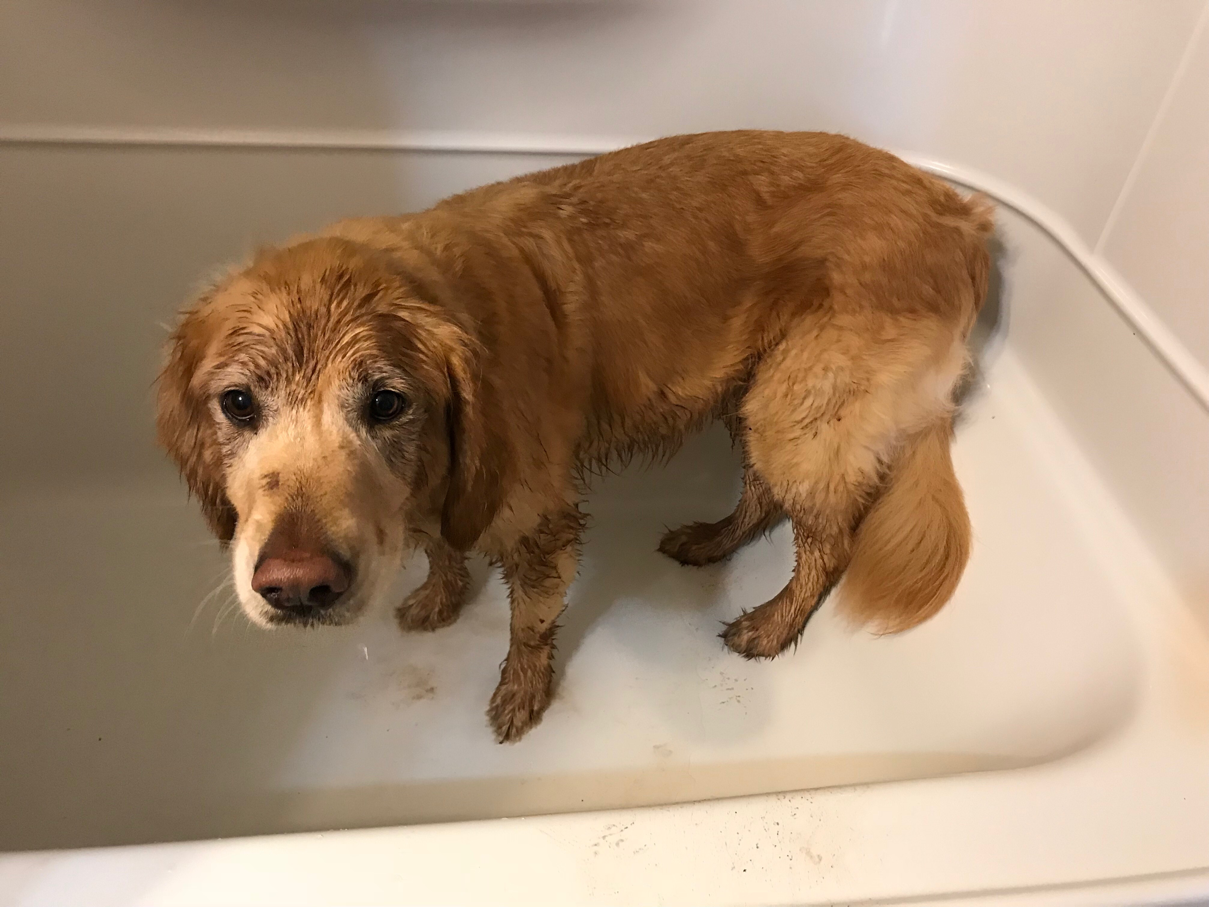
Georgie always managed to find the muddiest places and puddles, just like a young child.  


Bath time was inevitable afterwards.


On this particular day, a friend found Georgie, safe, across the busy road in someone’s yard. She was eager to go with him and when she arrived home, was anxious to go inside, wet and cold as she was.


After a quick shower,


she spent the rest of the day by the fire while her family sighed in relief.