

It’s curious how an object can take you back in life. The scythe was hung in the shed at Doucet House in Rustico, Prince Edward Island. It is in rough shape now, not having been used or maintained in years.

My grandfather owned and used a scythe to mow the hay for the animals. This time of the year, he worked hard to provide for the coming year. Granda died in 1972, a few hours after having mowed hay. Working to his last day, he died as he would have wanted.
The days of the scythe are long gone as machinery has taken over the family farm and industrialized farming has taken its place. The horse and cart my grandfather used to transport the hay are part of the history books, part of the fond memories from my youth. The smell of the hay, clothes and hair covered in the dried grass, are etched in my sense memory.
It may be part of the reason that at every opportunity, I pause to look at and photograph bales of hay and straw on fields today on Prince Edward Island. Beginning every summer and continuing into the fall, bales sit on the fields ready for collection.
The view near French River, shows signs of the fishery in the foreground, a golf green and bales on a field.

At the National Park at Cavendish, bales sit in cottage country.

Near the park at Brackley Beach, the back and forth rows made by the harvesting machinery make what looks likes tracks for the bales.

On a friend’s field one evening at dusk, I had the chance to see the straw bales at field level

and up close.

From the Confederation Trail, the fields are bordered with trees and wildflowers.

The trees on the Trail provide a frame for a lone bale.

Last fall, the colours of autumn added another dimension to the common scene near Bonshaw Park.

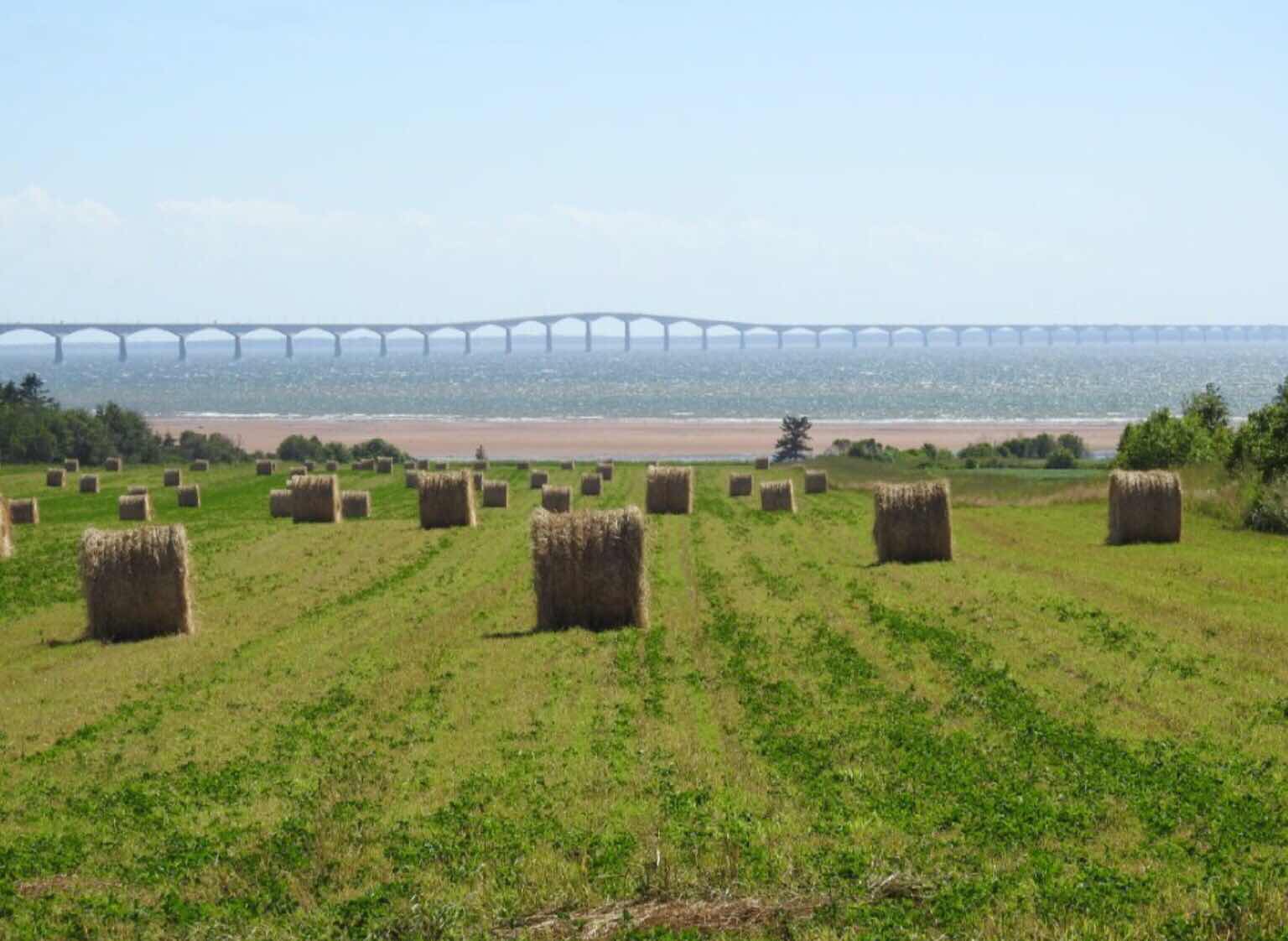
Finally, the Confederation Bridge is the backdrop for the bales, a scene which changes every year with the crops on the field.
These views from our island home are some of my favourite farm scenes.