Most Popular Post

Sunday, 8 June 2014

Berber

June 7  The  Ourika Valley at the base of the High Atlas Mountains is a short bus ride from Marrakech, (pronounced Maura-koosh by the locals, with a rolled r.) It is a lush, verdant valley compared to the dry countryside around Marrakech. Perched on the lower slopes of the mountains surrounding this valley, live the Berber people.

                                                               Ourika Valley

These people are descendants of the first people to settle Morocco. They have their own language, some Muslim, some Jews. They live in tribes and marry within them. 

                                              Mud homes hundreds of years old

We visited a Berber home in the Ourika Valley today. It was constructed of mud, straw, whatever was available hundreds of years ago. The stable is at the entrance of the house where the donkey and a cow had their quarters.  The woman of the house, Lalla Zahra, hosted us while her husband was farming. We had a tea ceremony with her and watched as she made the mint tea. We sat around their equivalent of our living room and were served bread, olive oil, fresh churned butter and honey. 

                                          Stable in the front of the house

                                        Lala ready for the tea ceremony

                                                   Lala Zahra in Arabic

Despite the heat, the home was cool because of the thick mud walls. It was also clean and comfortable, two bedrooms with beds lining the walls plus other rooms. The people clean themselves using steam baths. The home got running water last year after the King visited the tribe and discovered they didn't have it. The kitchen was ancient compared to modern standards but adequate for the family's use. They use charcoal and tagines for cooking as well as a gas stove top.There was a roof top area with a great view of the countryside and the little community.

                                              Kitchen in a Berber home

The woman herself communicated with the tour guide, Abdul, in her language. She had six children, one boy and five girls. The married son lives with her. The daughters are married and live nearby. She doesn't know her age because they didn't keep records and weren't literate. Today the children are being educated and she has learned to read in the last three years. She seemed proud of that fact as she should be!

                                The roof of the house

During the tea ceremony, the woman used beet sugar to sweeten the fresh mint tea. It comes in 2 kg hard cone shapes. She broke off big pieces to put in the tea pots. Most of us there were from the Western world, older people, who are concerned about our consumption of sugar. We almost emitted an incredulous gasp to realize that she would use so much. ( They use 2 kg a day.) Abdul coaxed her into making some sweet and unsweetened tea which she couldn't understand, but complied. Her culture doesn't have the same concern for sugar with the type and amount of work that they do daily.

         Lala holding the white beet sugar cone

Her Berber home was steeped in her culture and history. She is a woman working to improve herself and provide for her family, like many women today. We are more alike than we are different.

                Pouring the tea

Thursday, 5 June 2014

Grateful in Medina

The old city, Medina, in Fes is another World Heritage site. The buildings are being restored for posterity, including the walls from the twelfth century. The town was started in 789 AD. Today there are 250,000 people living there. 

                                                        The Medina of Fes

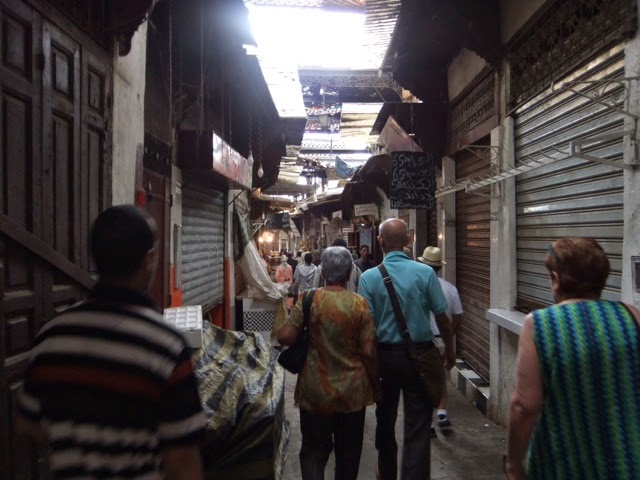
Step into the Medina and you are going back in time. The buildings are the same as they were many centuries ago, the narrow lanes, branching in all directions, seem like a maze to the uninitiated. Our guide, Momo, was born there and knew his way, giving tips on what was authentic Moroccan goods and how to conduct yourself.

                              Narrow lanes with stalls on either side

There aren't any cars in the Medina. Donkeys are used to transport heavy or multiple goods. In the narrow lanes you will periodically hear, "Balack," meaning, attention, move over. You must move aside to allow a heavily laden donkey and its handler through. In some areas the lanes narrow to small passageways, too small even for the animals. These lanes lead to peoples' homes. 

           Passageway to homes

We stayed in the lanes where business was done. One lane had numerous sewers who made wedding dresses. Other areas were for butchers, or bakeries where you bring your dough and they cook it for you; other areas had vegetables, fruits, dried fruit stands. There were stalls with jewelry, embroidery, rugs, leather. 

                                  Shoes, among other things for sale

                 Wedding dresses for sale

The people work hard and have a hard selling pitch if you stop or make eye contact with them. Then they expect you to haggle. They make an offer, you counter and so forth. I dislike this way to do business and I can never get a good price. However, I realize that this is a cultural thing and I respect their ways. The sellers were very aggressive with some of our group, especially for the rugs and leather.

                              Handmade rugs made by the women's co-op

My great grandfather Stewart was an engineer at the tannery in St. John's and his daughter, Min, was a machinist there. The visit to the tannery of the Medina, made me think of Old Tom and Min. The smell of the tannery was unique. The staff gave us fresh mint to hold under our noses while we were there. They took us to the roof to see the dyeing operation, just like it was done centuries ago. They tanned camel, goat, sheep and cow; all hides were worked beautifully into purses, jackets, wallets. They did fantastic work.

                                                         Vats of dye

It's busy in the Medina and the place is dark even at midday in spring because of the confined quarters or the covered lanes. The guide told us not to judge the places by the doors. They were lovely homes inside some of the doors. However, it was difficult not to be struck by the flies, other insects, sick or starving cats, and some impoverished looking people in the Medina. Some of the donkeys looked like skin and bone as well.

Walking through the Medina this morning, I was reminded how grateful I am for everything I have In my life. I really have everything I need; I am very blessed and every so often, I need to be reminded of my good fortune. Done!

Wednesday, 4 June 2014

Twelve Degrees

Who would have thought that twelve degrees would make such a difference? We flew across the Atlantic and eventually arrived in Spain. Over the last two days we've driven south across Spain until today when we crossed into Morcco. Four hours over what seemed like back roads and we're in Fez or as the locals call it, Fes.


What fascinates me this evening is that the sun is setting around 8:30 pm. By 9 pm,  it's completely dark. Over that half hour, the sky went from light blue, medium blue to deep blue and the waxing moon became more prominent as the colors deepened. 

At home in Prince Edward Island tonight, sunset is at 9:03 pm. However there is an extended twilight that leaves light in the western sky closer to ten pm. Light doesn't linger in Fes.

The reason of course has to do with degrees of latitude and distance from the equator. There is a twelve degree difference between Fes and Prince Edward Island, which is further north. The science is one thing but the experience is another. The difference in the time of sunset and twilight, or lack of it are very noticeable to a northern girl who loves the lingering daylight on those long spring evenings.

There's no place like home.


Tarifa to Tangiers

Today we left the hotel in Malaga  and headed to Tarifa to get the ferry across to Africa. Just a few minutes from Tarifa we stopped to view three countries, two continents and two bodies of water.

  Spain, foreground, Gibralter, Morocco-hazy line behind Gibralter-right and left, Atlantic to the right of Gibralter, Mediterranean to the left.

The three countries are Spain, Morocco and Gibralter (which is British.) The continents are Europe and Africa. The waters of the Atlantic and Mediterranean meet near Gibralter. It was an incredible sight to see the convergence of so many disparate things all laid out before you. (These distinctions are man-made.) Africa is so close to Europe with the Strait of Gibralter between them. It is interesting to speculate where the Atlantic ends and the Mediterranean begins and how the waters mix. It is also easy to see how the Moors could invade Spain because of its proximity to their native continent.

                                             Rick approaching the catamaran

A catamaran took us across to Africa, fast and rough though the seas didn't appear so. It reminded Rick of his trips on The Runner when he was working on the southwest coast of Newfoundland. Today however we are headed to Tangiers and on to Fes. The bus is tucked in below deck and our fellow passengers are dispersed throughout the boat as Africa approaches. Numerous languages are spoken around us, a mini United Nations. 

And there it is, Africa! We're docked and going through customs. Another dream come true.

                                                     Welcome to Tangiers

Tuesday, 3 June 2014

Look Up

Granada (Spanish for pomegranate) is a beautiful city which is crowned by the Alhambra Palace. It is the the only complete remaining Renaissance Arabic (Muslim) palace in the world, another World Heritage site.

Alhambra, overlooking Granada, is a feast for the senses, the sights, sounds and smells a trio of beauty. The eyes are drawn upward to see the walls of the palace, the birds and the craftsmanship, while the scents of linden trees, and myrtle waft through the air. Sounds of the birds, especially the swallows, circling the towers and courtyard are mesmerizing to see and enchanting to hear. The running water in the many fountains and from the periodic glimpses of the aquaducts help create the sense of tranquility.

                 The original garden

Most amazing however is the workmanship of the place, ceilings and walls. Constructed by the Muslims starting in 889 AD, it was built of plaster, wood, marble, ceramic. Details such as the use of moulds to create the intricate plaster walls, the wood or plaster patterns on ceilings, the patterned ceramic tile on walls or marble columns meant to withstand earthquakes, all make this palace unique and beautiful. 

                            Ceiling in the queen's bedroom

                       The Queen's eyes, windows which overlooked Granada

This palace was home to the Muslim rulers of what is now Spain until it
 was turned over to the Spanish in 1492 when the Muslims were finally defeated. Another Spanish king added a building inside the palace walls but no one has ever lived in this building. The Spanish have maintained the palace ever since and have done an amazing job. 

                                                       Granada

Only seven thousand people go through Alhambra every day. But every day seven thousand of us get a chance to admire the engineering and craftsmanship of those men from centuries ago. I am glad to have been one who had the opportunity today to look up.


Monday, 2 June 2014

Holy Toledo

Monday, June 1: The rolling hills of olive trees zip by as we make our way to Granada but memories of the morning are going through my mind. We left Madrid this morning and drove to Toledo, pronounced To-led-o by the Spanish and by me forever more. I've had an image of Toledo in my mind for a long time, from a painting by El Greco. Just like a dream come true, there it was.

                                               Looking across to old Toledo

Toledo is the most beautiful city I've ever visited. Pictures can't capture it. It is a combination of old and new, but the old is exceptional. The old walled city is connected by bridges to the newer part of Toledo, and a walk through the old city takes you back over a millennium in some places. After a few days in Spain however, that isn't the amazing part any more. The amazing part now is the beauty of the buildings and their surroundings with the history of the city.

      Cars and people share these streets!

When I was growing up, the phrase Holy Toledo was in common usage even in Newfoundland. It was used as an exclamation like 'holy smoke.' Seeing Toledo today explains so much of the origins of the term.  Spain like so much of the world, was conquered by different peoples. The result here and in many ways unique, was that for eight hundred years, Christians, Jews and Muslims lived in harmony in Toledo, thus holy Toledo. Then the Spanish Inquisition happened. Goodbye harmony. Today there are only 30,000 Jews in the country of 46,000,000 and only 1,500,000 Muslims.

                                                           Yummy...cheese anyone?

Toledo has a Jewish quarter though today there aren't any Jews there. However the influence of the Muslims and Jews on the city is still very obvious. As an example, we visited a synagogue in the Jewish Quarter which was built by the best artisans of the time, the Muslims. The design of the building, faciing towards Jerusalem, has wood ceiling, plaster walls and arches typical of the Muslim style. Later it became a church after the Jews converted to Christianity or left the country, which was the ultimatum they were given.

                      Synagogue in Toledo

The relationship that was working so well was destroyed. However, mutual respect, tolerance and co-operation built a beautiful place which is a testament to what harmony among people can do. We need  Toledo of old but on a world scale. 

                                                             Happiness in Toledo

Holy Toledo!

Sunday, 1 June 2014

Old

When you come from the New World, your sense of 'old' is very new. We spent the better part of yesterday at Segovia, Spain where a huge section of the aqueduct, circa 100 AD, built by the Romans, is still standing. The stones and form are not constructed with mortar, pressure keeps the granite stones in place. Amazingly arch forms are suspended this way. The Romans built it and the Spanish have maintained it, though it has not been used for water transport, with a few exceptions, for about one hundred years. It is an incredible sight in the center of the lower level of the city.

                                              Aquaduct at Segovia

Old in the New World is much less so of course. In the city of St. John's where I was born, anything older than one hundred years or so is exceptional. This is because that city was destroyed by fire several times in its history of being the oldest English-founded city in North America, circa 1583.  In Segovia, one of the houses on a road leading to Plaza Mayor is 500-600 years old. It has thick stone walls, built to last and older than St. John's.

             Imagine owning that front door!

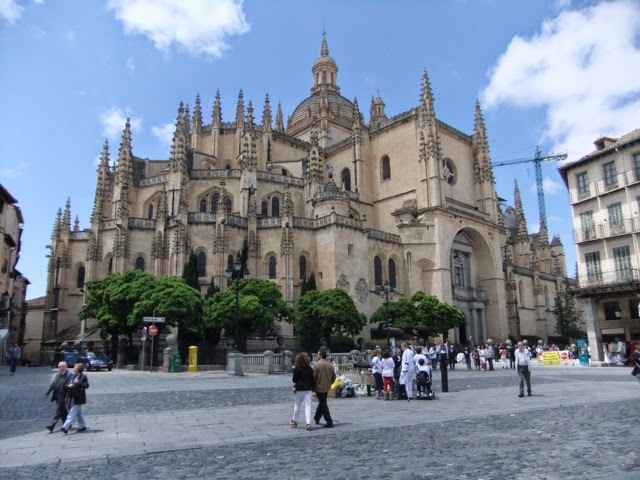
The Segovia cathedral and the Alcazar or royal palace are just beautiful as well, making this a World Heritage site well worth a visit. However, the people were the main attraction with their custom/traditions and culture. Early Sunday morning, the streets were empty, except for a few stragglers headed home from the bars the previous evening. Then for those who attend Church, there are Sunday services, followed by visits to restaurants where tapas, beer or wine are served. 


                   Segovia Cathedral, made of sandstone, difficult to repair

At the Plaza Mayor on Sunday, a brass band played a variety of contemporary music which attracted many and kept them from their aperitif. After we had toured the Alcazar, the previously crowded streets were empty, between three and four o'clock, as the people had lunch. The Spanish often eat their evening meal very late in the evening, nine or ten o'clock. Time spent socializing with friends and family is a priority and the people appear relaxed and happy. 

                                                       Alcazar Palace


  Palace display: The poor horse, carrying all that weight

Old can be amazing in many ways and especially when it comes to engineering, architecture and traditions.

                  Streets after four o'clock