Most Popular Post

Showing posts with label Acadian. Show all posts

Wednesday, 28 November 2018

The fisherman

He stands in the harbour at North Rustico, Prince Edward Island. The fisherman statue represents the Acadian fishers of the 1920s who used handlines to catch fish, an environmentally friendly method which was labour intensive. His right hand holds the handline and in his left, a fish.


The Indigenous people, the Mi’kmaq, had camps in this area 6000 years ago. White men sailed along this shore in the 1500s. In the 1700s they began fishing this area and by 1800, Acadians had settled here. Their descendants still live here today.


The statue illustrates the importance of the fishing industry to the area. Fishers can trace their ancestry back through many generations. The sea and their quest to feed their families and make a living have shaped who they are.


As the sun goes down, the bronze fisherman stands in the dimming light, the water lapping at the base which supports him. 


He becomes a shadow now, but is as real to his progeny as he ever was. He is part of them, a gene in their make-up, a link in the family chain. Day or night, wind or rain, water or ice cannot affect him any more. He lives in their hearts.

Wednesday, 5 September 2018

Lunch at Doucet House

When I first saw Doucet House in Rustico this past spring, the gray-blue sky appeared to sit on the roof of the old place. 


However on this summer day, the house, believed to be the oldest on Prince Edward Island, looks like it is smiling. And no wonder!


The old house was built in 1772 by Jean and Marguerite Doucet, an Acadian family, on a site across the bay. There they had nine children. The house stayed in the family until 1982. In 1999, the new owner donated the little house as a museum and work began to transport it across the bay to sit next to the first Credit Union in Canada. 


My husband and I couldn’t see the inside of the building in April but we could visit on this day. There are three rooms on the main floor. The largest contains the kitchen, with the stone fireplace in the center of the house, where food cooked over the open fire. 


The original walls are visible today but sometime in the life of the house, were covered with sheet rock. It was removed during restoration but leaves its trace on the old wood.


Two bedrooms complete the main floor, a smaller room 


and a larger with a double bed and a mattress filled with straw. 


There is a half story above which was used for storage.


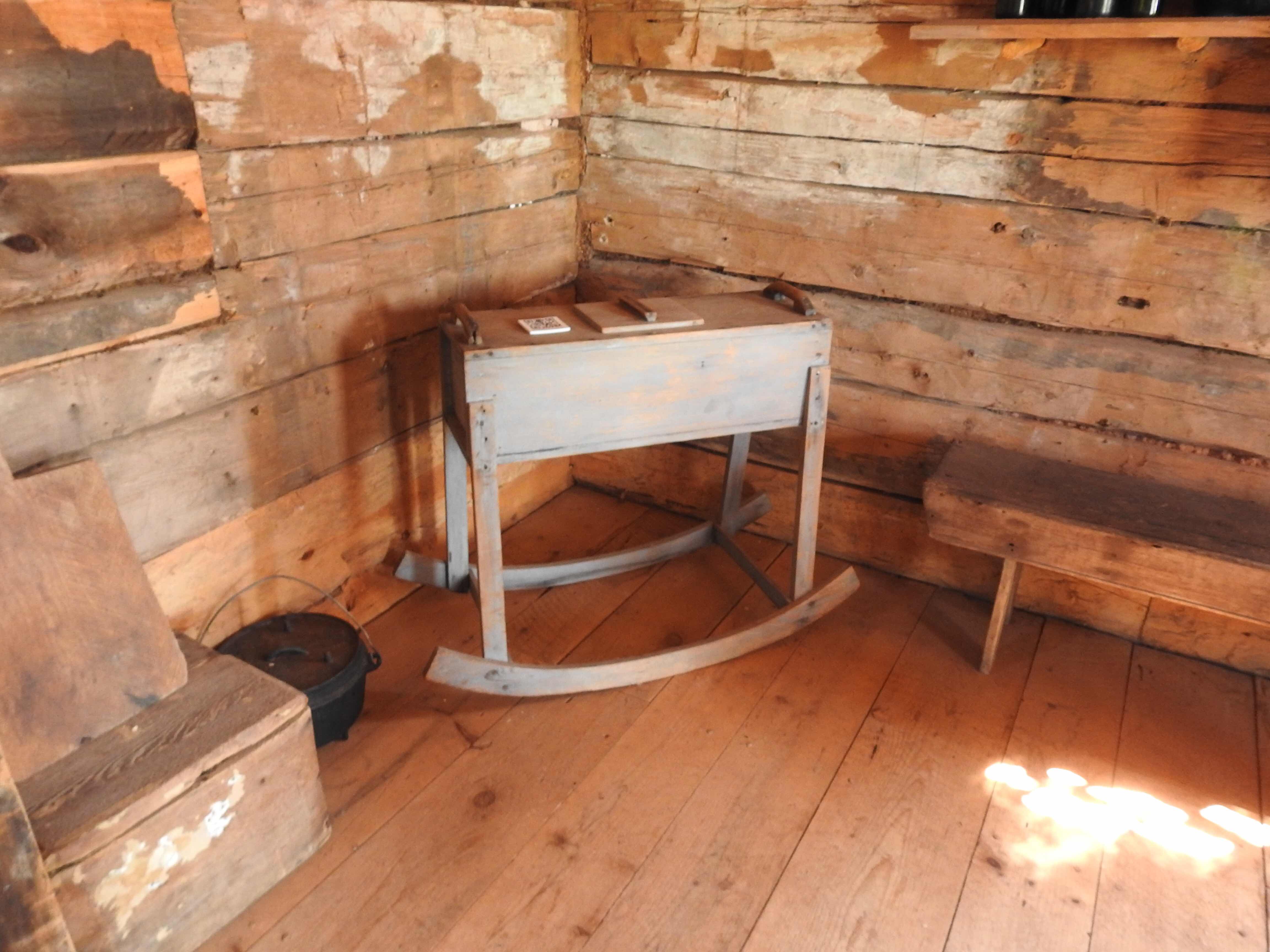
The furniture was donated by local Acadian families and includes items such as an old butter churn 


and reminders of spinning


and weaving. 


Outside, the community oven cooked bread and other staples for all the Acadian families in the area.


The fire started at the front of the oven and the coals were pushed to the back to make room for the food to bake.


There is a shed with the usual items such as a yoke for oxen 


and a wooden seeder. An old manual washing machine, invented in the United States  in 1846 and in common use until 1927, must have been a blessing to the women who used it originally.


We had our picnic outside as we imagined the ghosts of those first Acadians going about their daily lives all around us. They were great company.


Friday, 9 June 2017

Evangeline

We recently visited the Francophone area of Prince Edward Island, the Evangeline region, just west of Summerside. The area is home to Acadians, 


French speaking descendants of the original French settlers to the island, who survived the expulsion at the hands of the British from 1755-1764.


Headed to Evangeline, my husband and I stopped first at a nearby provincial park at Linkletter. Here, at high tide, walking on the tons of seaweed was akin to walking on sponge.


The Confederation Bridge is visible in the distance as is the Indian Head Lighthouse at the entrance to Summerside Harbour.


Further along the south shore, we dropped by the park at Union Corner where the bridge is visible again but appears as a mirage in the middle of Northumberland Strait.


The layers of sandstone in the shoreline here are thinner than any we've seen elsewhere. 


Nearby, the shoreline was lined with cottages, some of which were fortified against erosion.


The lobster fishery begins in the summer on the south shore so the wharves are not busy as they are on the north side. In Evangeline, boats are still high and dry, waiting their turn at the lobster. We did spot one retired boat, which had seen better days. 


A cultural center in Abram Village is the site of summer musical performances in the Acadian tradition. 


Those musicians on the Galerie walls will be joined by those inside playing Acadian music. And of course, there is the food!


Acadian festival


Further along the coast, in the community of Egmont Bay, a beaver was busy in the Jacques River which flows out of Arsenault's Pond.


She, like the other beavers we've seen on the island, was impossible to photograph, as she disappeared under water when we tried a closer look.


The Jacques River has a fish ladder which allows trout, salmon, smelts and Gaspereau to swim up-river. Both the river and the pond above are licensed for sport fishing. 


Gaspereau, the Acadian term for alewife, is a type of herring which swims from the ocean inland to spawn, as do smelts. The ladder makes it easier for the fish to get into the pond. 


We were familiar with fish ladders from our days living near the Exploits River in central Newfoundland. There, Atlantic salmon, much bigger fish than smelts and alewives, use the ladder at Grand Falls-Windsor to swim up-river. We didn't see any fish negotiating the ladder in Egmont Bay.


We enjoyed our exploration of part of Evangeline and will return soon.


Friday, 17 March 2017

A rapure frolic

One of my favourite things is learning about other cultures and traditions. This includes family recipes which are passed down for generations. Learning a new recipe and the stories behind it are wonderful ways to share our lives over a meal and learn about each other. 

We had a frolic which in Prince Edward Island denotes any occasion when people get together to work on a project. Women had frolics for knitting, crocheting, or quilting as examples. Men had frolics to cut wood or build a shed. Ours was to make rapure, a traditional Acadian dish. We had baked apples for dessert.

While she lived in Prince Edward Island, my mother-in-law, Sylvia, became friends with some Acadians. It was a pleasure for us to get to know this important part of our community. Their kindness and friendship helped Sylvia during the two years she lived on the island.

Our curiosity about Acadian customs and culture led us to the preparation and sharing of this Acadian meal. Four of us prepared the rapure and baked apples. It was both fun and delicious. My husband shared our completed meal as well.

Our friends were Angéle and Eleanor. Angéle is Acadian, raised in Mont Carmel, PEI. Eleanor's husband, Eldon, was Acadian too. Eleanor is from St. Augustine on the lower north shore of Québec. My mother-in-law, Sylvia, a fellow Newfoundlander, helped in the kitchen that day with her friends. 

 
                                                     Eleanor, Angéle and Sylvia

Acadians are descendants of the early French settlers to Canada. When the British gained control of what is now the Canadian Maritimes, they drove the Acadians out of their homes. Some island Acadians fled to the woods and hid, later re-establishing themselves in the Evangeline area of western PEI. These families have kept their language and culture alive and they are a vibrant part of our island home. Acadians have a proud heritage which we were eager to know.


Angéle's father was a fisherman who also grew vegetables and raised animals. Her mother raised the children and kept the house. She made rapure for her large family as a special meal. It is made with pork and grated potato, so it was labour intensive in the days before food processors. With ten children, you can imagine the amount of potato needed for the family and the grating was hard and time consuming work. The family loved the meal but it was not a common item on the menu.

                                               
                                                                Rapure

We used 10 pounds of Russet potatoes in this recipe. You must peel and boil at least five medium to large size potatoes in salted water. While the potatoes are boiling, peel and grate the remainder of the potatoes. Keep them in water to prevent the potatoes from darkening. Angéle says the best rapure is made with potatoes grated on a box grater. Today, a food processor hastens the work. Rinse the grated potato well and drain in a colander just before combining with the other ingredients. 

Meanwhile, cut a pork shoulder roast, about two to three pounds, into bite size cubes, trimming the fat. Saute the pork with one large chopped onion in oil. The meat and onion can be browned in the oven if you prefer.

When the potatoes are boiled, mash them and combine with the drained grated raw potato, pork, onion, salt and pepper to taste. Eleanor's mother-in-law also added summer savoury and coriander to the recipe, though Angéle's family did not. We added a pinch of savoury.

When ready to put the rapure in the oven, Angéle made the sign of the cross over the food saying, "St. Theresa and St. Martha, bless me that I may make a good rapure." Her mother always said this blessing and Angéle does the same blessing for bread.

Place in greased pan(s) large enough to hold the recipe. We used two pans. Cook on 400 degrees F for one hour, then reduce the heat to 350 for a second hour. Check that the rapure is browning during the second hour and increase the heat if it is not browning as you would like.

Cut the rapure into serving size pieces to plate and add molasses as you would to a pancake. The rapure is crispy on the outside and tasty, even without the molasses.


Angéle's mother used the fat from the pork as well, not wasting a bit of the roast. The flavour from the fat and its presence in the rapure changed it from the recipe we have today, using only lean meat. However, her Mom's recipe for that time provided needed calories for the hard working family. Today, we are concerned with cutting fat from our diets any way we can. 

For dessert, we had a traditional island recipe of baked apples. We washed and cored the apples and put some brown sugar in them as well as chopped dried cranberries. You can use raisins also. A tablespoon of butter over the top of each apple helps create a nice sauce. Cook on 350 degrees F until the apples are tender, about 70 minutes in our oven.

The two pans of rapure we made were different thicknesses. Some people prefer the rapure thin, with the crispiness going through the slice. Others prefer it thick with the crispiness on the top only. We made it both ways to see which we preferred.

Prince Edward Island is an ideal place for growing potatoes so the rapure was a great recipe for families who grew their own potatoes, enough to carry them through to the next year if they were lucky. Some had animals as well, as did Angéle's family, though the children were not happy to see their named pets on the dinner plate. Apples grow well on this island too and many families had the trees on their property. They were an important part of every family's diet and apple trees are plentiful to this day.

Like Newfoundlanders further east in the Atlantic Ocean, Acadians lived off the land and sea. We have so much in common in spite of the difference in our first language. Rapure will become part of our menu in the future and we will remember our friends and their traditions every time we make it.